Narrative Process Design
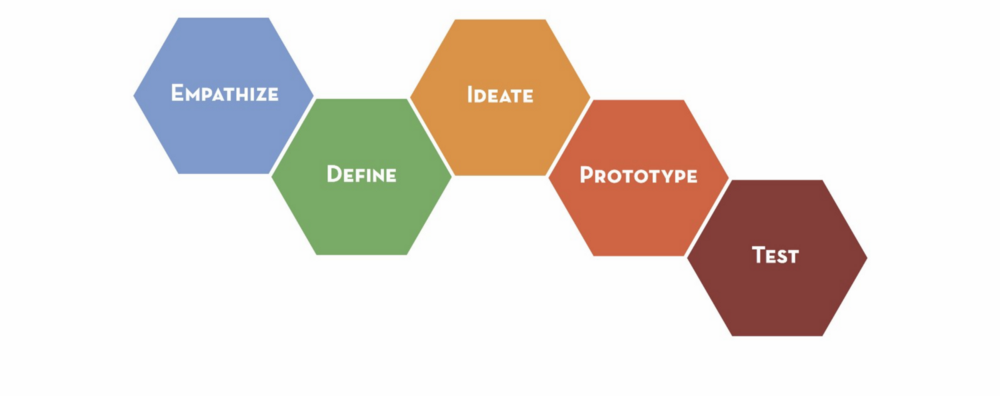
My Design Process
User-centered design is centered around research, design, and testing to determine what makes the user's best experience. Although I have studied various types of user-centered design, I have found a narrative approach to be most effective. Narrative Process Design examines why, how, and what impacts a user throughout their story. And my responsibility is to figure out how I can design a more holistic journey for them. Throughout each of my projects, I strive to cultivate constant vigilance in conducting reliable research and creating research-based experiences that meet the user's needs and narrative.
DEFINE
My process shares its roots with the Customer experience lifecycle, exploring the stakeholder journey (Journey Map below). The journey map conveys how a "customer" starts with a need for something. They research what they need. They select the thing they want and then purchase it. The hope is the customer will spread their thoughts by word of mouth to recommend the product/service/company. Then, the customer and company maintain their relationship with each other. The customer's history with the company to use the services to have an easier time in the future. They then receive updates, gestures, billing, and a continuing dialog from the company to create a future need.
I look at this lifecycle as a direction for us as user experience designers to follow when defining experiences we are trying to create within our work that infuses into the company. These overarching principles are essential to consider how each user interacts not only with a service or product but instead the overall experience that surrounds their entire interaction. How a user approaches their journey to work with anything, decides where to go when they want something, know they get something reliable, and has a sustainable and growing experience with ultimately you, the designer, as a guide to this journey.
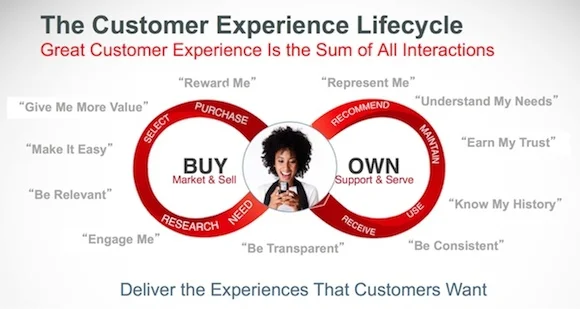
by Derek Bell presenting B2C Customer Service Journey Map
Joesph Campbell describes the journey I am talking about. An American mythologist, writer, and lecturer, best known for his work in comparative mythology and comparative religion, his work covers many aspects of the human experience. Campbell's magnum opus is his book The Hero with a Thousand Faces (1949), in which he discusses his theory of the journey of the archetypal hero found in world mythologies. Since its publication, Campbell's theory has been consciously applied by a wide variety of modern writers and artists. The best known is perhaps George Lucas, who has acknowledged Campbell's influence on the Star Wars films.
Campbell explores the theory that important myths from around the world which have survived for thousands of years all share a fundamental structure, which Campbell called the monomyth. In a well-known quote from the introduction to The Hero with a Thousand Faces, Campbell summarized the monomyth:
"A hero ventures forth from the world of common day into a region of supernatural wonder: fabulous forces are there encountered and a decisive victory is won: the hero comes back from this mysterious adventure with the power to bestow boons on his fellow man."
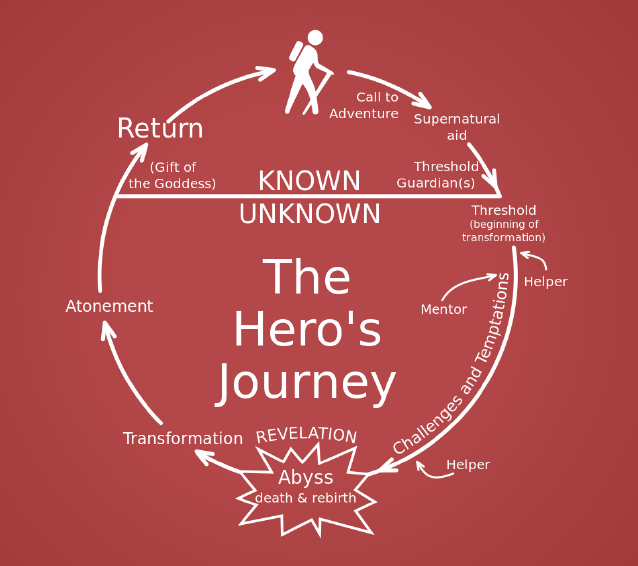
In laying out the monomyth, Campbell describes several stages or steps along this journey. The hero starts in the ordinary world and receives a call to enter an unusual world of strange powers and events (a call to adventure). If the hero accepts the call to enter this strange world, the hero must face tasks and trials (a road of trials) and may have to face these trials alone or may have assistance. At its most intense, the hero must survive a severe challenge, often with help earned along the journey. If the hero survives, the hero may achieve a great gift (the goal or "boon"), which often results in the discovery of important self-knowledge. The hero must then decide whether to return with this boon (the return to the ordinary world), often facing challenges on the return journey. If the hero is successful in returning, the boon or gift may be used to improve the world (the application of the boon).
The classic examples of the monomyth relied upon by Campbell and other scholars include the stories of Osiris, Prometheus, the Buddha, Moses, Mohammed, and Jesus. However, Campbell cites many other classic myths from many cultures which rely upon this basic structure.
But how does it work?!
Storytelling comes naturally to humans, but we sometimes need a little help doing what we'd naturally do since we live in an unnatural world. Below is the user progression of a narrative journey with any service, product, or experience.
Let's simpilfy that
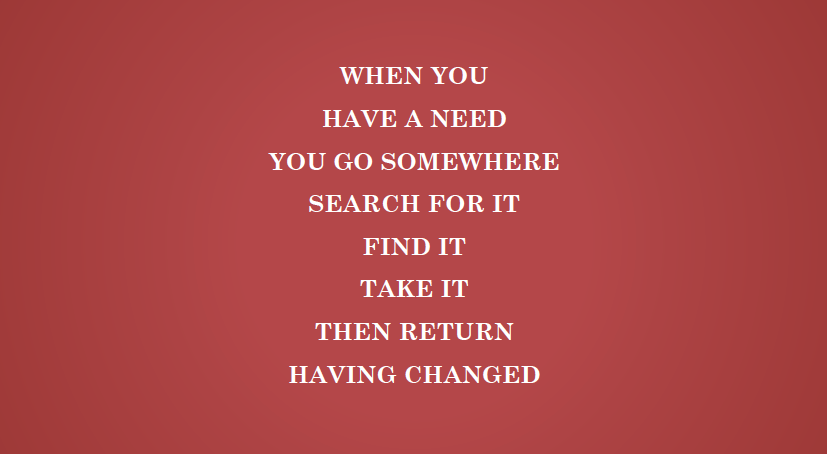
One more time
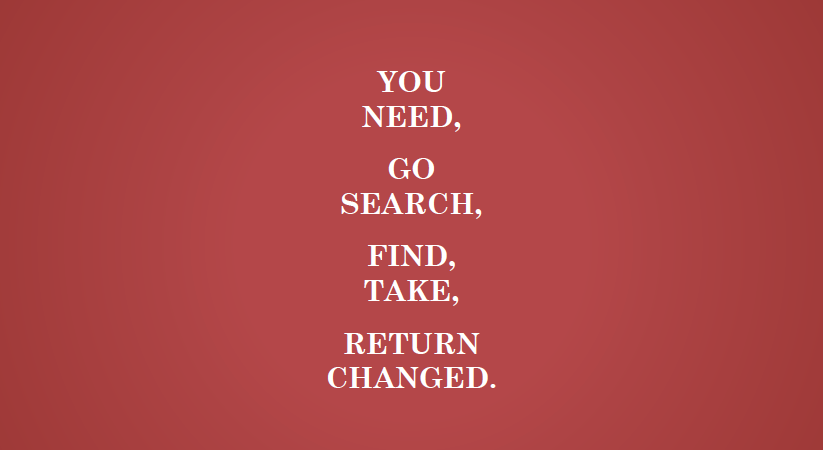
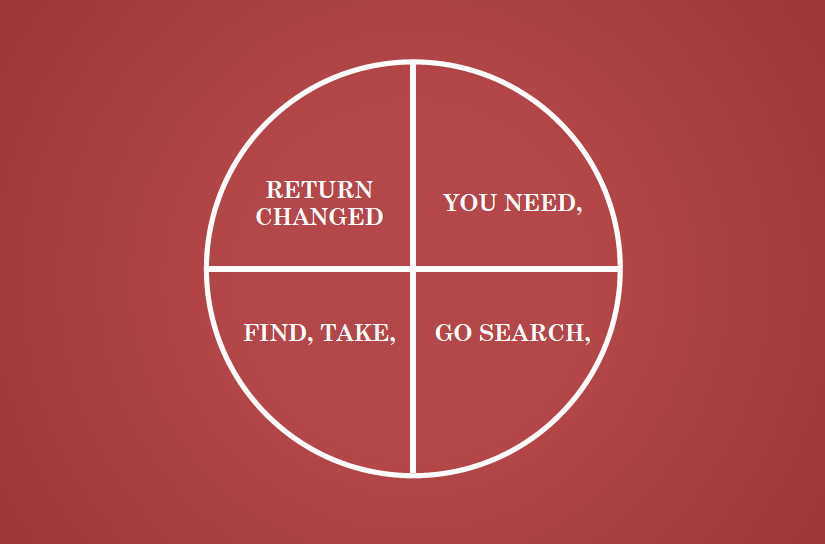
Now take what you have seen and apply it like so
Draw a circle and divide it in half vertically.
Divide the circle again horizontally.
Starting from the 12 o clock position and going clockwise, number the 4 points where the lines cross the circle: 1, 3, 5 and 7.
Number the quarter-sections themselves 2, 4, 6 and 8.
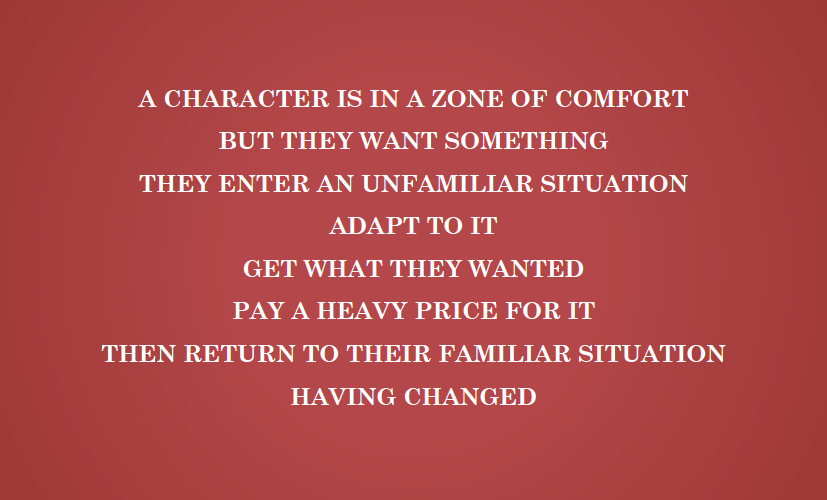
A character is in a zone of comfort,
But they want something.
They enter an unfamiliar situation,
Adapt to it,
Get what they wanted,
Pay a heavy price for it,
Then return to their familiar situation,
Having changed.
Start thinking of as many of your favorite movies as you can, and see if they apply to this pattern. Now think of your favorite party anecdotes, your most vivid dreams, fairy tales, and listen to a popular song (the music, not necessarily the lyrics). Get used to the idea that stories follow that pattern of descent and return, diving and emerging. Demystify it. See it everywhere. Realize that it's hardwired into your nervous system, and trust that in a vacuum, raised by wolves, your stories would follow this pattern. This pattern presents itself fairly easily in the design process.
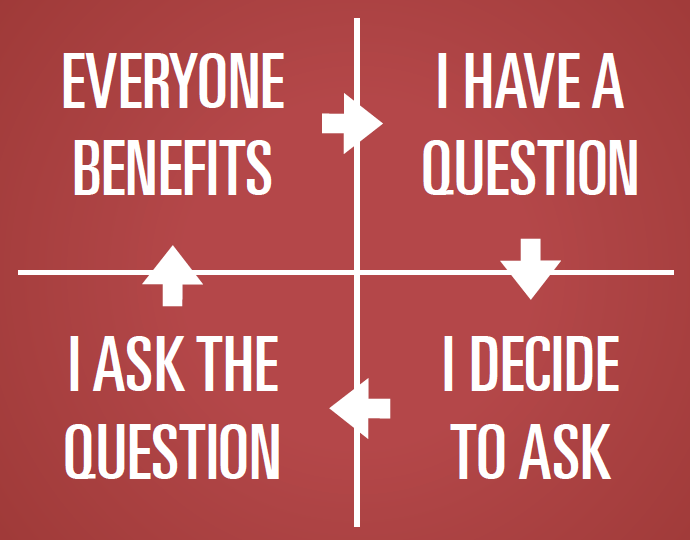
IDENTIFY
There are multiple steps within Identify, the first of which begins with identifying a clearly scoped design problem. A design problem begins with “How might we..?” and segues into the “for who?” As a user-centered designer, I begin each project with stakeholder analysis to determine who the ‘u’ is in the ‘UX.’
How do I do this? By asking and answering:
Who?
What?
Where?
When?
Why?
How?
After answering these, I identify the thoughts, feelings, and values that are important throughout the design process about the product, service, or company. Consider each question during the user's journey.
The "YOU" in the story circle or, in other words, the Audience and where will find out the "Need." The need comes from empathizing with the user group you are trying to help. As designers, we want to understand their struggles to know how best to serve and help users. I continue this in the next step.
When we identify who the audience is, we must also empathize with who they are, where they are coming from, what positions they take, their thoughts, and much more. To figure this out, we can perform.
Empathy Mapping.
EMPATHY MAPPING
Empathy maps help team members understand the user’s mindset.
Definition: An empathy map is a tool used to articulate what we know about a particular type of user. It externalizes user knowledge in order to 1) create a shared understanding, and 2) aid in decision making.
Characteristics:
The map is split into 4 quadrants: Says, Thinks, Feels, Does.
It shows user’s perspective regarding the tasks related to the product.
It is not chronological or sequential.
There is one empathy map for each persona or user type (1:1 mapping).
Why use it:
To build empathy for your users
To force alignment and understanding about a user type
When to use it:
Beginning of any design process
When categorizing research notes from a user interview
RESEARCH
User research is the next integral step in my design process. Here, I strategize which research methods of my toolkit would best triangulate the design problem. I’m passionate about research because this is where I can genuinely understand, empathize, and design for people.
What tools would not only corroborate but best complement each other?
Who are the users?
What are their goals, their pain points, and their current behaviors?
How are they different from each other?
Through selected qualitative and/or quantitative methods, these are the questions that I seek answers to. My identified key stakeholders must become involved as early as possible to ensure transparency and encourage engagement throughout the design process.
I discover and understand where the user's "Go" and "Search" stages are in this stage.
It doesn't matter how small or large the scope of their story is. What matters is the amount of contrast between the world the user started in and is going towards. The user will start wanting something more, and these two stages are the attempts to try and get there. Our help is needed (usually) to see where the pain points are at this point, fix them, and see if it improved their process.
DESIGN
Now that I’ve identified and researched the who, what, when, where, and why I’m designing, I can use my creative ninja powers in the Design step - the how. I start with the information architecture (my niche interest) and the user flow. If appropriate for the project, I analyze and model what data, information structures, and relationships are necessary to drive the suggested flows and interactions. I then design, story frame, sketch, and connect wireframes that would best solve the identified personas’ specific problems. How would a user interact with this screen? Are there appropriate affordances and feedback for the user? Do they know where to go next? How to go back? What are the possible next steps?
Storyframing
I have recently started integrating a new technique into my process called story framing. Story frames are a hybrid document between a script/story and a wireframe. This process answers, "How would I explain this thing/topic/product/story I am trying to communicate to a friend in a conversation or an email?" It works by writing down the product's story to answer this question. Then, aggregate and trim the length. Story frames look like a script, focusing on hierarchy and page structure rather than layout or final copy. I give this to the team I am working with as an exercise to see where we all believe the story to be and, when combining, find out more of what the product or service will look like. Also, giving this exercise to a client to help see from their point of view what they want out of the product or service will help shape the final result. When you have a more refined story, you can get more detailed by asking:
What is the best way of displaying that information?
Which modules are made of parts of the text?
Which parts of the story can you replace with images, videos, or short animations instead?
Which parts of the story can you complement with those same resources?
Which specific proof points do you want to display to back up your arguments?
After going through your page story, which actions do you expect people to take?
More information about this is in the Fabricio Teixeira article "Storyframes before wireframes: starting designs in the text editor" here
WHAT DO WE DESIGN?
When designing, we need to consider our users as part of something more. They are not only using the product but sometimes searching for it or commenting on it or reviewing it or recommending it to someone else, and so on. We are designing spaces that transcend one type of use for one group but instead an ecosystem that is flexible to hold various user groups and bend to new circumstances that arise when users switch roles.
TEST
Onwards! Usability testing is where I re-engage with users and evaluate how successful they are in completing tasks to reach their goals. Testing is where users validate designs and iterate to incorporate new findings. I can continuously refine my techniques with each successive, focused round of testing. Moreover, usability testing may also prompt additional questions, some of which are answered by further user research and suggest other design implications.
By designing and testing, we can see how well our plan to change the process reflects how the user "Finds" and "Takes" the information or product to be used. As an IA, my task is always to be thinking of these two steps the most. I would say they are the most crucial to what I do. The navigation to information, its structure, the labeling, the searching, the accessibility...they are all felt by the user in this stage and where a majority of the problems are that need to be solved.
EVALUATE
In this phase, we look back at the design process up until this point and frame it against a lens to see where we are and where we need to go. We are trying to figure out the "Return and Changed" sections of the narrative. The evaluation stage also shares insights if the user has changed because of this experience.
Following my narrative process design, I use dualities to understand and answer why events unfolded the way they did, which sheds light on how to move forward.
Psychology
Why this ritual of descent and return? Why does a story contain some aspects in a specific order before the audience even recognizes it as a story?
Because our society, each human mind within it and all of life itself have a rhythm, and it resonates when you play in that rhythm.
This rhythm presents itself in many forms. Such as Psychology
Your mind is a home, with an upstairs and downstairs.
Upstairs, in your consciousness, things are well-lit and regularly swept—friends visit. Scrabble is played, and hot cocoa is brewing. It is a pleasant, familiar place.
Downstairs, it is older, darker, and much, much freakier. We call this basement the unconscious mind.
The unconscious is what it sounds like: It's the stuff you don't, won't, and/or can't think about. According to Freud, there are dirty pictures of your mother down there. According to Jung, there are pipes, wires, and even tunnels that connect your home to others. And even though it contains life-sustaining energies (like the fuse box and water heater), it's a primitive, stinky, scary place, and it's no wonder that, given a choice, we don't hang out down there.
However, your pleasure, sanity, and even your life depend on occasional round trips. You've got to change the fuses, grab the Christmas ornaments, and clean the litter box. To the extent that we keep the basement door sealed, the entire home becomes unstable. The creatures downstairs get louder, and the guy upstairs (your ego) tries to cover the noise with neurotic behavior. For some, eventually, the basement door can come right off its hinges, and the slimy, primal denizens of the deep can become Scrabble partners. You might call this a nervous breakdown or psychotic break; it doesn't matter. Occasional ventures by the ego into the unconscious, through therapy, meditation, confession, sex, violence, or a good story, keep the consciousness in working order.
The rhythm of psychology: Conscious-unconscious-conscious-unconscious-etc.
Order and Chaos
There is also a duality between order and chaos concerning the user.
Societies are macrocosms (big versions) of people, only instead of "consciousness," a society's upstairs is "order," and its basement is "chaos."
Whereas an individual's health depends on the ego's regular descent and returns to and from the unconscious, a society's longevity depends on actual people journeying into the unknown and returning with ideas.
In their most dramatic, revolutionary form, these people are called heroes. Still, every day, society is replenished by millions of people diving into darkness and emerging with something new (or forgotten): scientists, painters, teachers, dancers, actors, priests, athletes, architects, and most importantly, me.
Societies are macrocosms of people in another way: Eventually, they die. There is competition between different societies. The losers are eaten, and the winners reproduce.
Like people, societies become neurotic and can eventually break down when they make the mistake of thinking the downstairs shouldn't exist. In a human being, the equivalent would be diagnosable as symptomatic. Our basement is brimming with creepy crawlies, and the pressure on the door is building. There has never been a bigger need for heroes, and they have never been in such scarcity.
One of two things is going to happen. Someone's going to open that door and go down there, or that door is going fly off its hinges. Either way, social evolution will not be cheated of its rhythm and it's going to get sloppy. We all know it. We all walk around with that instinctive understanding in our unconscious minds.
The rhythm of society: Order-chaos-order-chaos-etc.
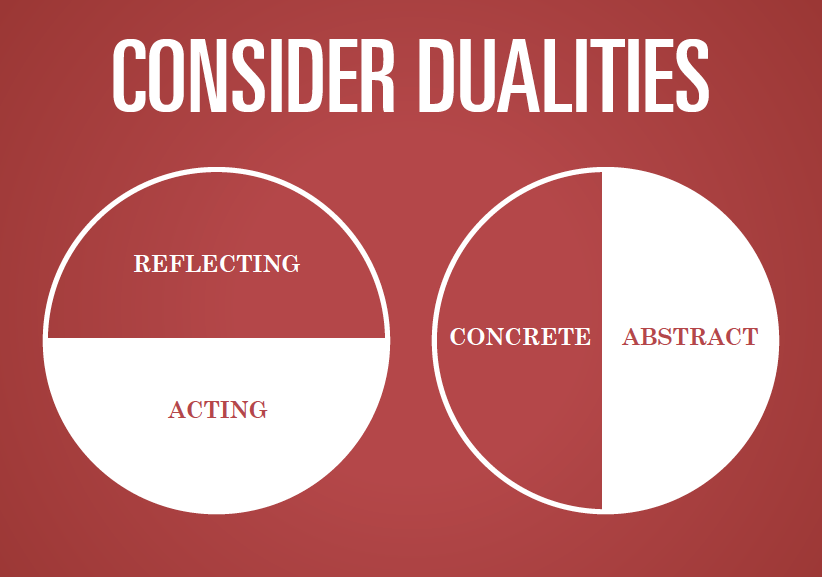
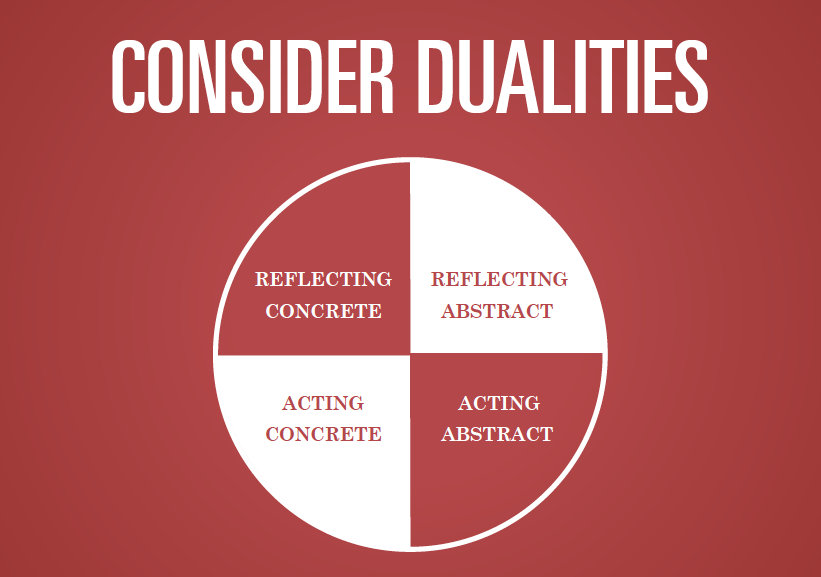
Reflecting on these dualities highlights behaviors, actions, thoughts, feelings, values, interactions, and practically anything else that will impact the user, practitioner, client, or business.
WHY?
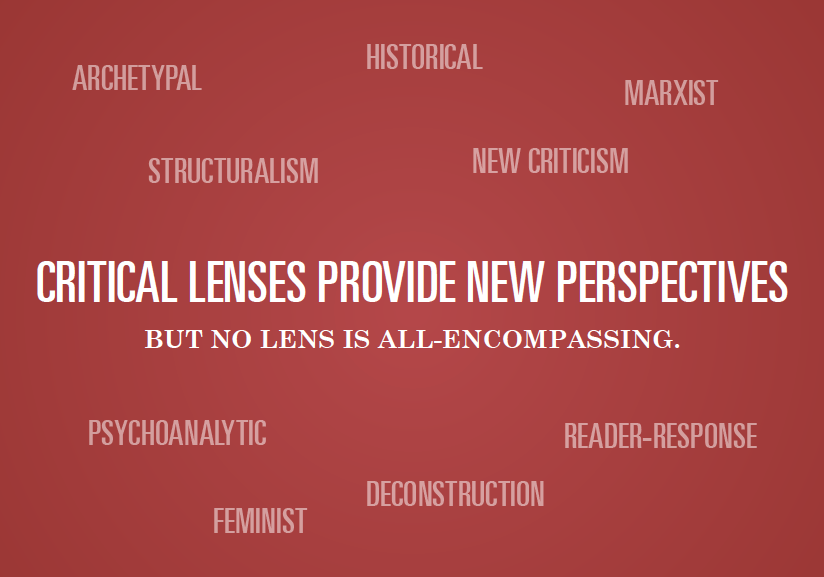
I choose the hero's journey story circle to develop a narrative process design framework because it is flexible and malleable. I can easily use this process to adapt to almost any user situation. Additionally, it has the bonus of being used as a critical lens within other design frameworks. So, it can be used as an extra piece to look at design aspects inside established processes. For example, it can look at user values in Values Sensitive Design, and it can use users from test cases, interviews, or usability testing to reenact small journey circles for Participatory Design, it can show the user side of Customer Service Design, and help refine information design experiences.
EXAMPLES
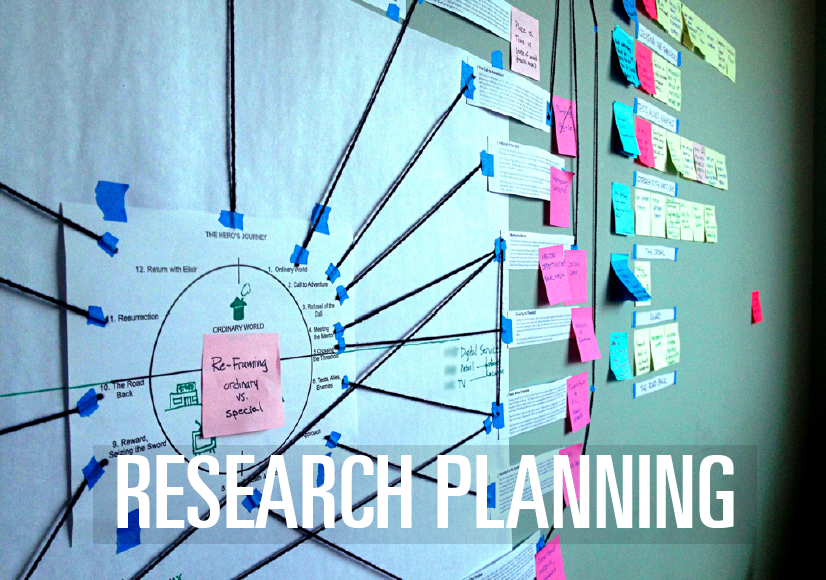
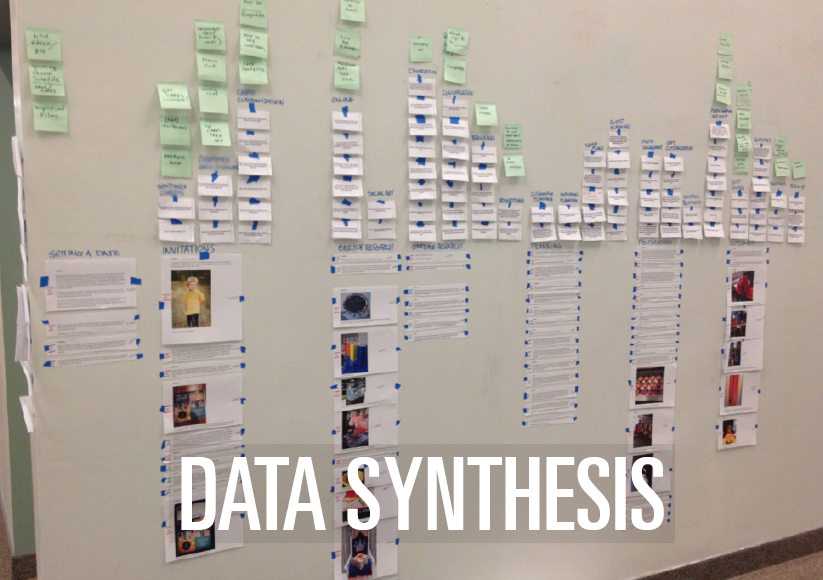
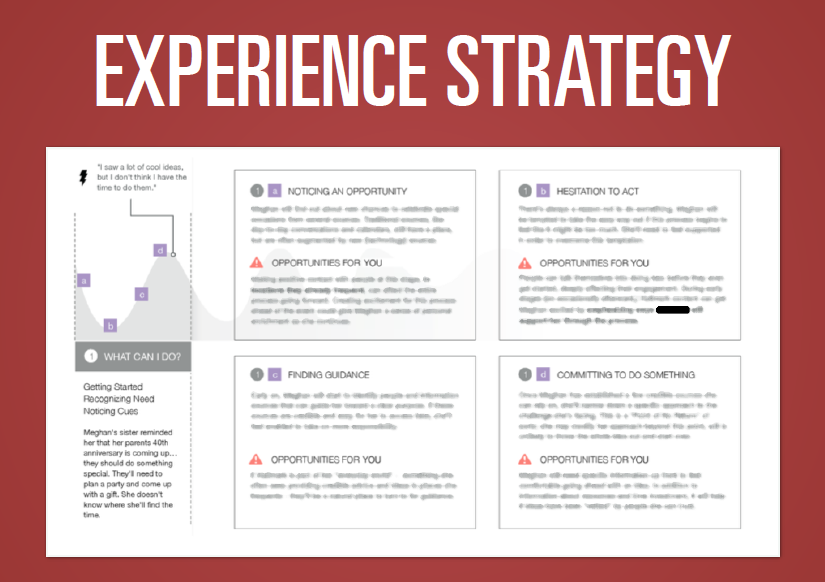
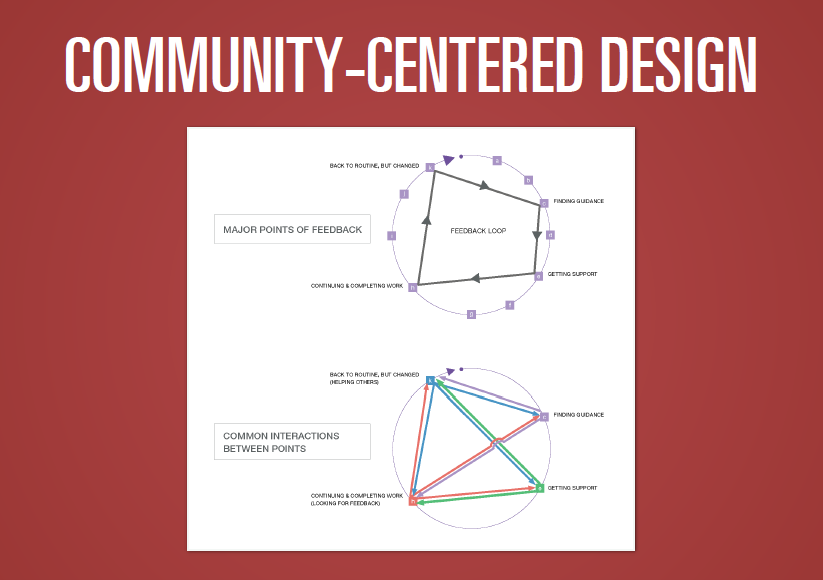
This process works for various types of design projects. Here are a few ways my narrative process could be applied.
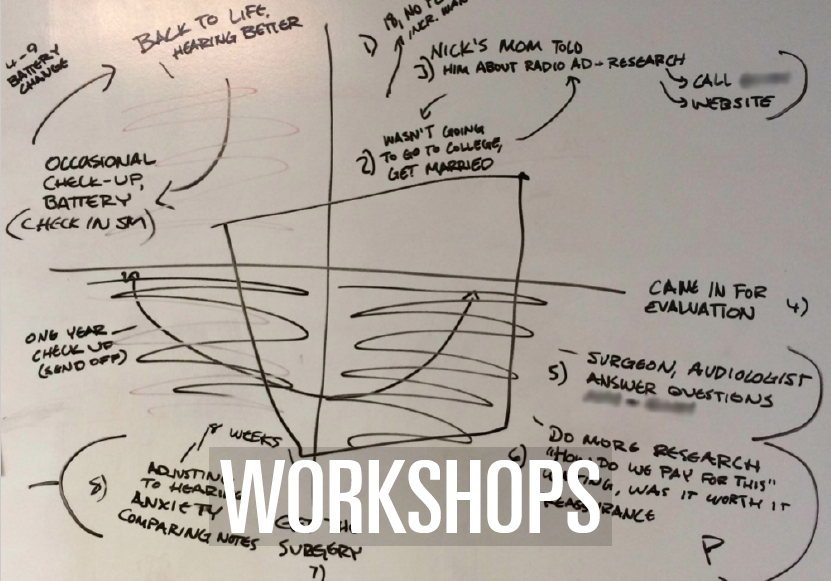
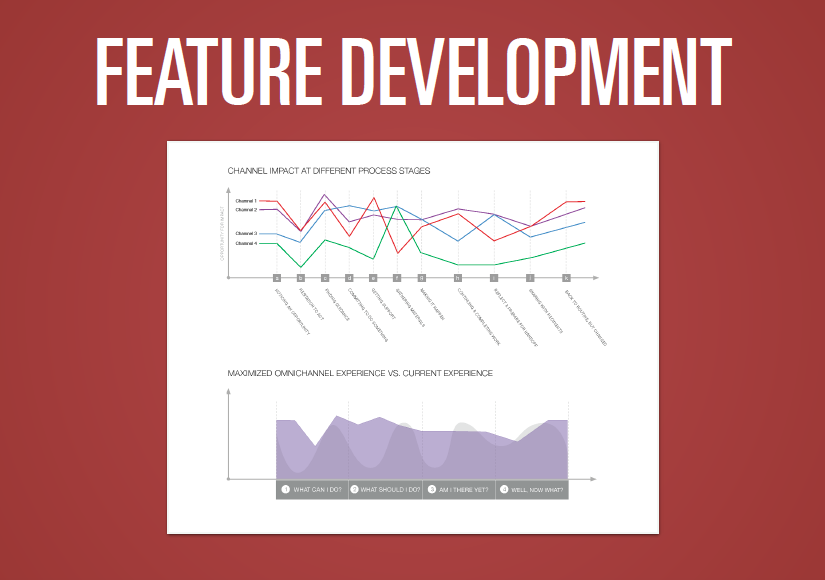
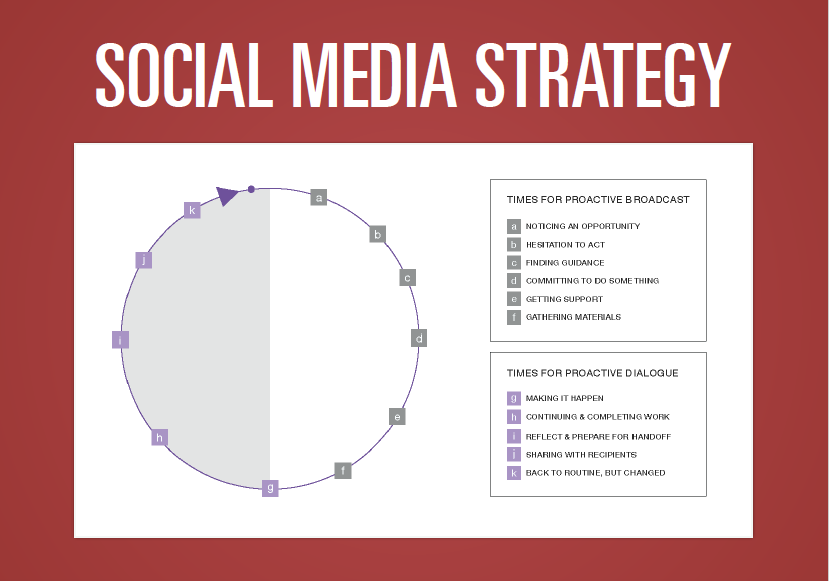
My design process ends when I have designed a solution that aptly addresses the goals and needs of the project, keeping in mind time and resource constraints. Using Narrative Process Design, we can do all of that and more.
Joseph Campbell's philosophy was "Follow your bliss." As a designer, I try to help the user attain it, structuring information to deliver a story and experience.